Product · 6 min read
Your Knowledge Should Stay Yours
Sergio Valentín Faúndez Velasco
July 12, 2026
Every organization already has an intelligence system.
It lives in the people who remember why a decision was made. In the manuals that explain how critical work gets done. In contracts, reports, presentations, policies, diagrams, and thousands of documents accumulated over years.
The problem is not that this knowledge does not exist.
The problem is reaching it when it matters.
A simple question can turn into a familiar ritual: search the shared drive, open five files, ask three colleagues, compare different versions, and still wonder whether the answer is complete. General-purpose AI can make that experience feel faster, but it introduces a more important question:
What should an organization have to give up in order to make its own knowledge useful?
Tengwar begins with a straightforward answer: nothing.
The knowledge you already paid to create
Organizations invest enormous effort in producing knowledge:
Engineers document systems and decisions.
Operations teams maintain procedures and incident records.
Legal and commercial teams create contracts and policies.
Specialists write reports that capture years of experience.
Teams build presentations, tables, diagrams, and technical manuals.
Yet much of that value remains locked inside files. Traditional search can tell you where a phrase appears. It rarely tells you how several sources fit together, which passage supports a conclusion, or whether a document is even visible to the person asking.
Tengwar is designed to turn that existing document collection into a knowledge experience people can actually use.
From “Where is that file?” to “Show me the evidence”
The experience is intentionally simple.
Your organization adds the documents it wants Tengwar to understand.
A person asks a question in ordinary language.
Tengwar finds the relevant evidence and prepares a grounded answer.
The person can inspect the cited source instead of trusting a mysterious response.
That final step matters.
A polished paragraph is not proof. Confidence is not provenance. In professional environments, an answer becomes useful when someone can trace it back to the report, page, table, or source that supports it.
Trust does not come from an AI sounding certain. It comes from making verification easy.
Tengwar treats citations as part of the answer, not as decoration added afterward.
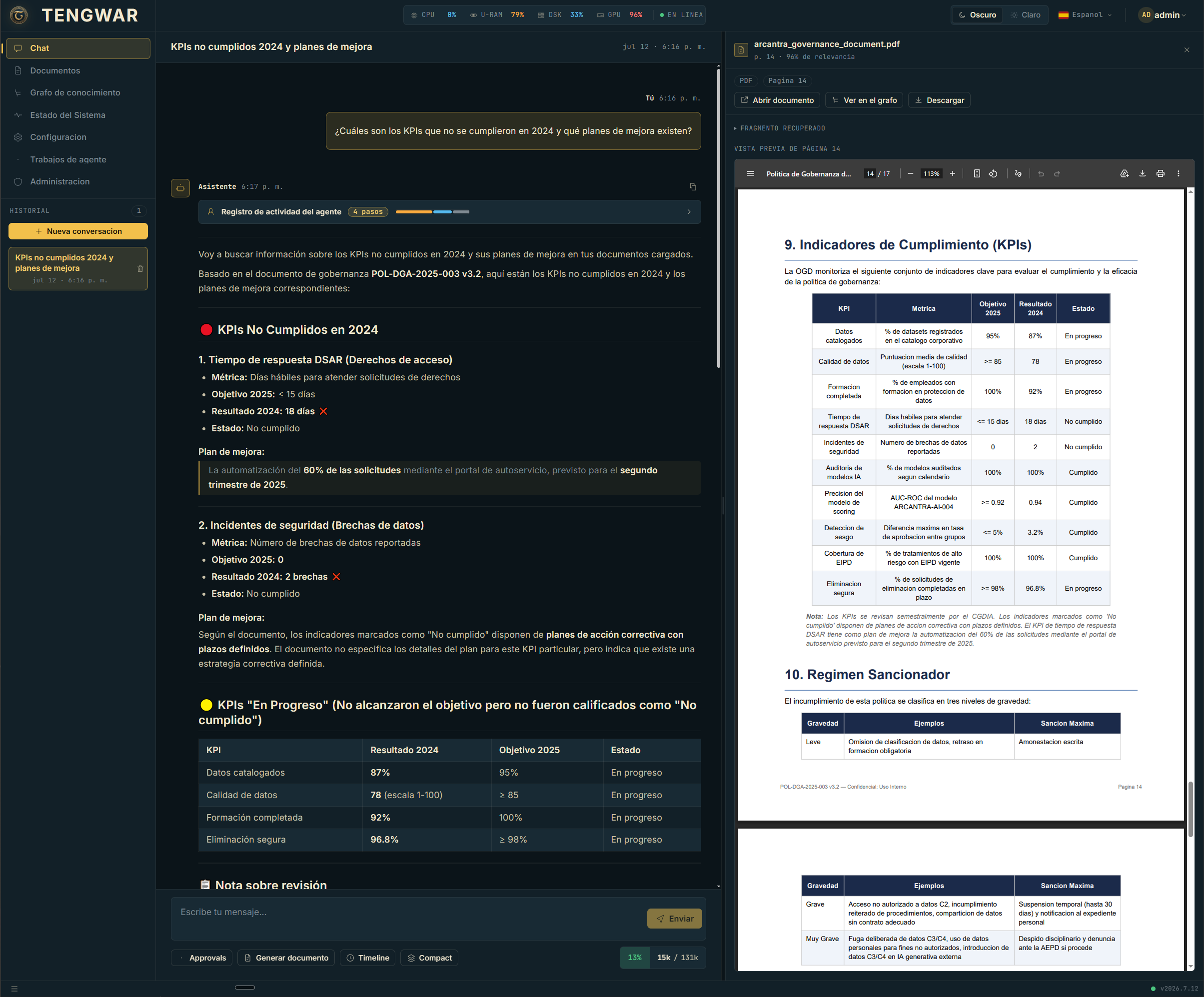
A grounded answer beside the exact document page that supports it.
Private by architecture
Many organizations cannot casually upload internal knowledge to a public AI service. The documents may contain intellectual property, operational details, commercial agreements, regulated information, or simply the accumulated experience that makes the organization distinctive.
Tengwar is built for a different deployment model.
The document corpus and AI model inference run on infrastructure the organization controls. Private documents do not need to be sent to a cloud LLM for analysis or answering. Administrators decide where the system runs, who can reach it, and which optional external capabilities are enabled.
This is not privacy as a checkbox. It is a boundary built into the shape of the platform.
Tengwar is on-premises, but it is not presented as inherently air-gapped. Features such as optional live web search or software distribution may use controlled outbound connections. The important distinction is that an organization does not have to surrender its private corpus to a cloud model provider in order to make that corpus useful.
The same intelligence, with the right boundaries
Organizational knowledge is not one undifferentiated pile of information.
A financial document may be restricted to one team. A project report may belong to a department. Some material may require a specific clearance level. An administrator may need operational visibility that a normal user should never see.
Tengwar carries those boundaries into retrieval itself.
The system considers the identity, role, department, and clearance of the person asking before evidence becomes part of an answer. The goal is not merely to hide a document in the interface. It is to prevent inaccessible content from entering the answer in the first place.
This allows one shared knowledge platform to remain useful without pretending that every person should see everything.
A simple experience, with a serious system underneath
Behind the conversation, Tengwar performs work that users should never have to think about.
It can recognize the structure of a document, distinguish prose from tables and figures, process scanned pages, preserve the surrounding context of an image, and prepare information for different kinds of search. It can connect related claims in a knowledge graph and combine several retrieval approaches before selecting the evidence used in an answer.
The result can be described without technical vocabulary:
flowchart LR
    A["Your documents"] --> B["Understood and organised"]
    B --> C["Relevant evidence"]
    C --> D["Grounded answer"]
    D --> E["Source you can inspect"]
Each stage exists to support the same promise: answers should be relevant, appropriately scoped, and verifiable.
There is substantial engineering behind that promise. Tengwar is designed as a complete self-hosted platform, combining document processing, local AI inference, secure retrieval, real-time interaction, storage, and operational controls on infrastructure the customer owns.
But complexity belongs inside the platform—not in the daily experience of the person using it.
Available where people work
Tengwar provides a shared experience across:
Windows
macOS
The web
The desktop applications can support the deeper integration expected from a native tool, while the web experience provides access without requiring a desktop installation. The same core interface and backend keep the experience familiar across those environments.
This matters because useful knowledge should not depend on everyone adopting a new working style. It should meet people where their work already happens.
What Tengwar is—and what it is not
Tengwar is not intended to be another general chatbot with a company logo.
It is a private knowledge platform designed around an organization's own documents, permissions, and infrastructure.
It does not remove the need for expert judgment. It gives experts a faster way to locate evidence, connect information, and verify what they are being told.
It does not claim that every answer should be accepted automatically. It is built around the opposite idea: important answers should remain inspectable.
And it does not ask an organization to choose between useful AI and ownership of its knowledge.
This is only the beginning
This first article is about the reason Tengwar exists.
The articles that follow will go deeper: how a document becomes searchable evidence, how different retrieval methods work together, how citations retain provenance, how the knowledge graph handles relationships and changing facts, and how a complete AI platform can share a single GPU host.
Those are technical stories, and we are looking forward to telling them.
For now, the principle is simpler:
Your organization created its knowledge. It should remain in control of it.
That is the idea behind Tengwar.
Sergio Valentín Faúndez Velasco