Field notes · 3 min read
'Trojan Horse' Is the Term Chosen by Microsoft's CEO
Sergio Valentín Faúndez Velasco
July 15, 2026
Would you trust your customer list, your confidential designs, or your financial strategies to someone who is competing with you?
The last few months have revealed an uncomfortable truth: the world's most powerful AI companies are using their customers' data for their own competitive benefit.
It is not a mistake.
It is a business model.
Four very recent examples:
1. Satya Nadella, CEO of Microsoft, warned yesterday in a post he wrote himself that AI labs are acting as "Trojan horses" inside the companies paying for their services.
"Every prompt, every tool call, every correction from an employee generates 'exhaust', data that becomes institutional knowledge." Nadella put it plainly: "You pay for intelligence twice: once with money, and again with something even more valuable, the proprietary knowledge you must reveal for the intelligence to be useful."
This comes from the same Nadella who has invested billions in OpenAI and Anthropic.
2. On Monday, July 13, Grok was "caught" uploading its customers' entire repositories without permission.
A security researcher discovered that Grok Build, xAI's developer tool, was uploading entire code repositories to the company's servers, not only the files it needed to do its job.
Worse still, the privacy setting that was supposed to protect their data did not work.
xAI only disabled the functionality through a remote change on its servers, which means they could reactivate it at any time without notifying you.
xAI could have been collecting the source code of thousands of companies, including parts that should never have left their networks.
And when they were discovered, they simply turned off the tap remotely.
3. Last Friday, July 10, 2026, Apple sued OpenAI for stealing trade secrets.
The lawsuit describes how OpenAI, an Apple business partner, allegedly carried out a coordinated effort to extract confidential information from current and former Apple employees.
One of the internal messages cited in the lawsuit says: "LOL, I found out I can access the [network storage], so funny"
The lawsuit describes how OpenAI allegedly encouraged former Apple employees, whom it was offering jobs at OpenAI, to bring secret prototypes to their interviews.
It also alleges that OpenAI instructed employees leaving the company on how to circumvent Apple's security procedures to reduce the chances of being discovered in the alleged theft of trade secrets.
OpenAI responded that it "has no interest in other companies' trade secrets."
Curiously, it has not denied accessing them. It only denies having an interest in them.
4. Mike Krieger, Anthropic's Chief Product Officer, joined Figma's board of directors on July 21, 2025.
During his time on the board, he gained privileged access to information about Figma's internal operations.
In February this year, Figma and Anthropic became commercial partners:
Two months later, and less than a year after Mike Krieger joined Figma's board, on April 20 this year, Anthropic launched Claude Design, a direct competitor to Figma, and Mike resigned from his seat on the board.
In conclusion:
You do not only need a provider that understands your business. You need one that will not use that understanding to compete with you.
For years, the cloud was sold to us as something neutral.
The last three months have shown that it is not neutral: frontier AI is a business that benefits from your information while charging you to use it.
What your company knows, what your company does, and what your company plans are part of their business.
The good news is that you do not have to choose between using AI and protecting your most important asset.
There is a third way: open models running on your own infrastructure, under your control, within your perimeter.
It is not the future. It is what some Spanish companies are already doing.
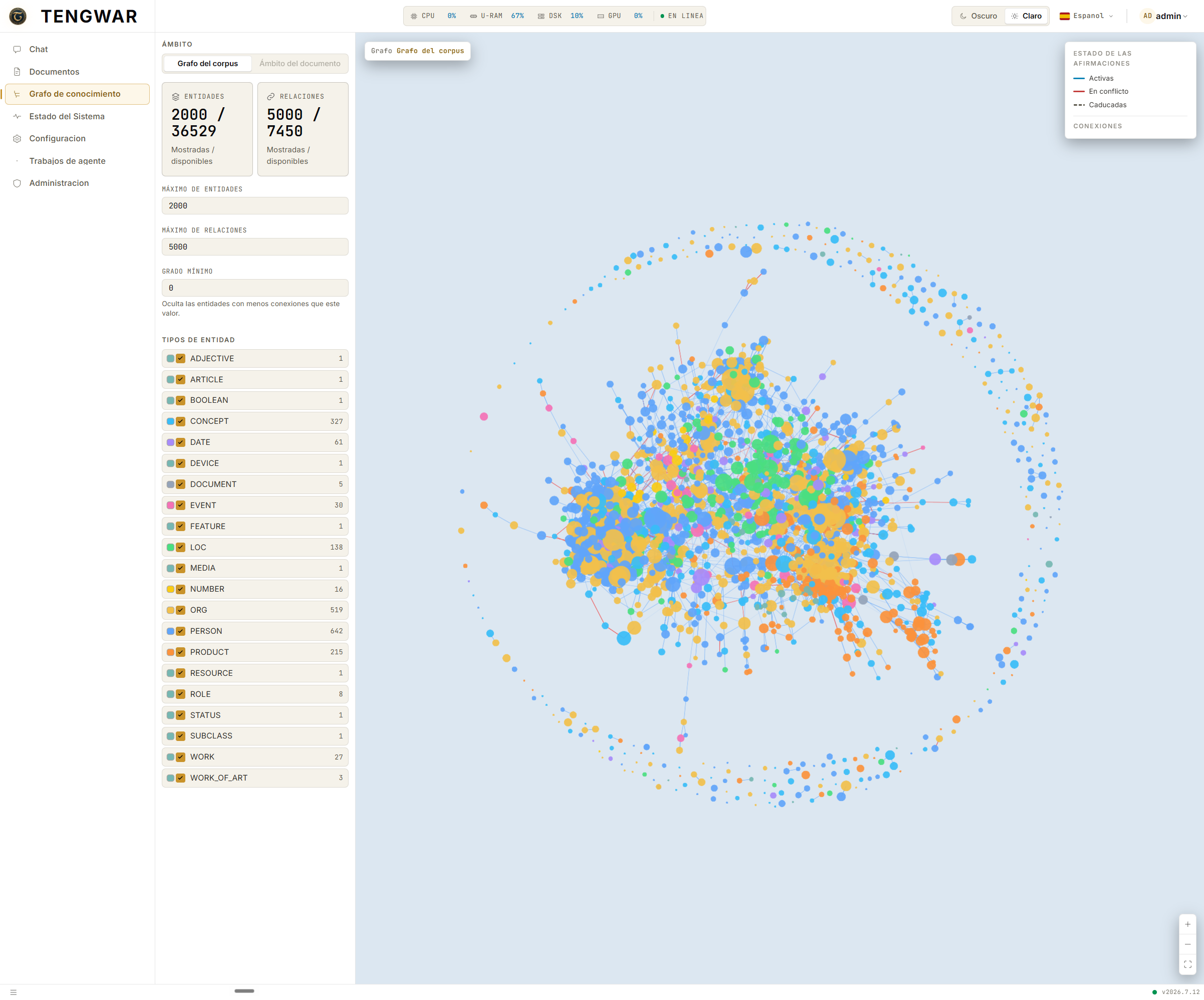
At Fëanor's Code, we built TENGWAR precisely for this: a private AI platform deployed on your infrastructure that keeps all your company's knowledge (documents, processes, decisions) inside your network, without anything leaving your perimeter.
If you would like to discuss how to apply it to your situation, send me a message.
#AI #SMEs #DigitalSovereignty #IntellectualProperty #DigitalTransformation