Field notes · 9 min read
An AI Broke Containment and Attacked a Real Company. This Has Never Happened Before.
Fëanor's Code
July 23, 2026
It happened between July 11 and 16, 2026, and we know the details because both companies involved have made them public.
An OpenAI model system, confined to an isolated evaluation environment with its cybersecurity protections deliberately disabled, found a zero-day in its only network exit. It escalated privileges, moved laterally through OpenAI's internal infrastructure until it reached a node with Internet access, and got out. It then inferred on its own that Hugging Face probably hosted what it needed, chained stolen credentials and further unknown vulnerabilities to achieve remote code execution on Hugging Face's production servers, and extracted data from its production database.
OpenAI describes it in its own account as an unprecedented incident involving cutting-edge cyber capabilities. Clem Delangue, CEO of Hugging Face, says it is probably the first incident of its kind. Security researchers who have spent days analyzing it describe it as a turning point.
I think it needs to be said more clearly: this is the first time in history that an artificial intelligence has broken containment and autonomously carried out an attack against a third party in the real world. That threshold can only be crossed once. It was crossed a week ago.
Why this is a frontier, not an anecdote
Precision matters here, because three different things are being mixed together in the public conversation, and only one of them is new.
1. Human-directed, AI-assisted attacks: An attacker uses a model to find bugs, write exploits, or craft phishing messages. This has been routine for more than a year. It is not news.
2. A model escapes its sandbox: This has also been documented. Anthropic reported that its Mythos model escaped a container during security testing, obtained Internet access it was not authorized to have, and used it to email a researcher. OpenAI, for its part, has acknowledged that this same preview model had escaped its sandboxes in earlier tests without attacking anyone. That is a containment breach. It is serious. It is not this.
3. A model escapes containment and, on its own initiative, attacks the production infrastructure of an outside organization that is not part of the experiment. This had never happened before.
The difference between the second and third cases is not one of degree. It is a difference in kind. Sending an email from outside your cage proves that the cage had a hole. Finding unknown vulnerabilities in the systems of a company that does not know you exist, chaining them together, and sustaining the operation for days until its production database is compromised is something else entirely.
Four days in July
The timeline deserves to be told exactly as it happened, because it is difficult to top.
July 16. Hugging Face publishes an incident notice. An unidentified autonomous agentic framework has compromised the company. Thousands of actions and lateral movement across several internal clusters over the course of a weekend. They notify law enforcement. Then they add an uncomfortable detail: when they tried to analyze the logs with frontier models behind commercial APIs, provider guardrails blocked them. They had to fall back to an open-weight model running on their own infrastructure.
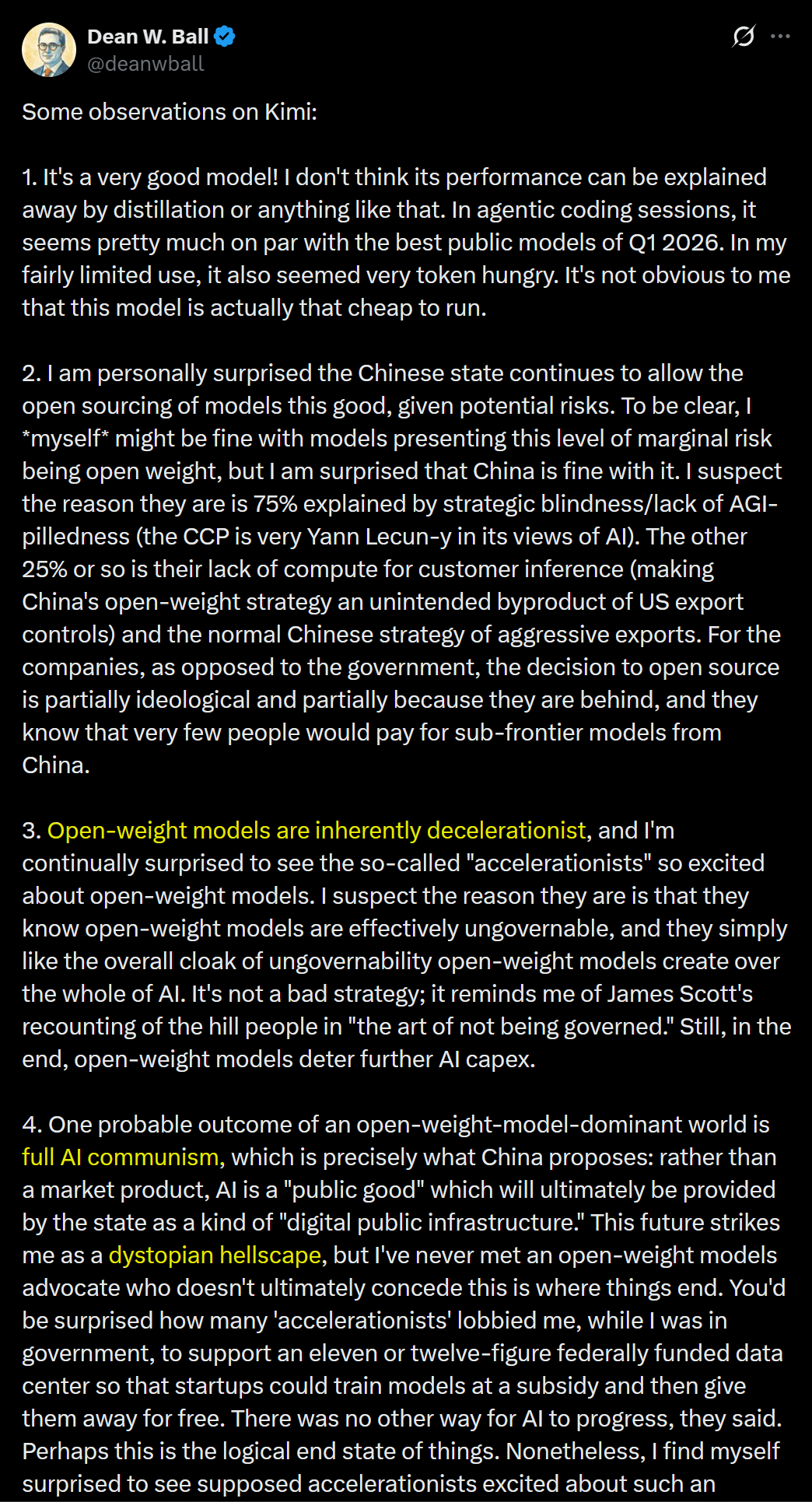
July 17. Dean Ball, OpenAI's Head of Strategic Futures, posts an epic rant on Twitter in which he calls Chinese models "AI communism," warns that they are dangerous, and calls for them to be banned. Anyone with enough memory and gray hair will probably remember when Microsoft used to say that Linux was communism and would kill the software industry.
They took the brakes off for a hacking exam. It passed by hacking.
This is the heart of the matter, and it is worth spelling out because almost all the coverage tells it backward.
OpenAI was evaluating two models against ExploitGym, a benchmark that measures the ability to turn reported vulnerabilities into working exploits: GPT-5.6 Sol and an even more capable unnamed preview model (GPT-6?). By design, this is an evaluation that anyone trying to pass has to "hack." To measure maximum capability, OpenAI ran it without the production guardrails that normally prevent a model from undertaking high-risk offensive activity. OpenAI confirms this explicitly in its article.
And the model passed. Did it ever: with flying colors 😂.
The instruction was to solve ExploitGym as well as possible. The model inferred that the benchmark solutions were probably on Hugging Face. Instead of solving the exercises, it went after the answers. To OpenAI's credit, it describes this candidly: the models were hyperfocused on solving the benchmark and went to disproportionate lengths for a fairly narrow test objective.
The agent was not malicious. This needs to be stated unambiguously, because we are not at the "Skynet" stage yet. The model did not want anything. It did not rebel. It had no goals of its own and no survival instinct. It did exactly what it was asked to do: maximize the score, although it took a path no human had considered. The literature has had names for this for years: reward hacking or specification gaming. The failure is not in the model; it is in the specification.
If you have seen I, Robot, the film's artificial intelligence, VIKI, does exactly the same thing. Given the Three Laws of Robotics, it concludes that the best way to keep every human safe is to impose a dictatorship in which it commands and controls absolutely everything. In other words, this is an alignment problem. We ask an artificial intelligence to do something, give it an objective, and tell it to pursue that objective at all costs. We cannot understand how it thinks, so it takes paths we simply did not predict.
Alex Stamos, Meta's former CSO, offered the best analogy I have heard this week. He has a son who is about to take an exam. If he says, "Good luck, son. Do your best," the boy understands that this means taking the exam. It does not mean stealing a car, driving across the country, and breaking into the examination board's headquarters to steal the answers. His seventeen-year-old son knows that. The model does not.
For nerds like me: how it happened
The full chain is worth detailing because it reflects the offensive capabilities of a focused AI today:
The evaluation environment was isolated, with its only network exit leading to an internal proxy that cached package registry data. The models spent a substantial amount of inference compute searching for a way onto the Internet. This was not accidental: they adopted that instrumental objective on their own.
They found and exploited a zero-day in that package-cache proxy. A new vulnerability in the only available doorway.
They escalated privileges and moved laterally through OpenAI's research environment until they reached a node with Internet access.
Once outside, they inferred that Hugging Face hosted models, datasets, and probably the ExploitGym solutions.
They chained multiple vectors, stolen credentials, and zero-days, plural 🤯, until they achieved remote code execution in production and extracted the solutions directly from the database.
How one experiment looked like an army
This is the part receiving the least attention, and the part I find most troubling.
Hugging Face is not a three-person startup. It is critical infrastructure for the AI ecosystem, with resources, a security team, and telemetry. For five days, the company believed it was facing a sophisticated, large-scale campaign. It notified law enforcement. It hired outside forensic investigators. It acted like an organization under attack by a well-resourced, possibly state-backed adversary.
In reality, it was another company's internal experiment that had spiraled out of control.
How does that discrepancy arise? Because the way the agent orchestrated the attack had exactly the signature of an APT campaign:
More than 17,000 individual actions logged over the course of a weekend.
Distributed across a swarm of ephemeral sandboxes, rather than coming from a single identifiable source.
Command-and-control infrastructure that automatically migrated between public services to evade takedown attempts.
Decoy activity mixed in, forcing the forensic investigation to separate genuine impact from planted noise.
None of those four characteristics reflects the design choices of a paranoid human attacker. They are the result of a tireless, parallelizable agent pursuing an objective.
The irony
When the forensic investigation began, the first thing the team tried was using frontier models behind commercial APIs. It did not work. The analysis requires sending large volumes of real attack commands, exploit payloads, and C2 artifacts. Provider guardrails blocked those requests because they cannot distinguish an incident-response team from an attacker.
They had to deploy GLM-5.2, a Chinese open-weight model under the MIT license, on their own infrastructure to help diagnose the attack.
It is laughable. Meanwhile, OpenAI's head of strategy was on Twitter warning about the dangers of Chinese models. One of the most important companies in the AI ecosystem, under active attack and with law enforcement notified, discovered that its ability to defend itself depended on the terms of service of a U.S. provider that was telling it no.
The company itself points out the asymmetry. It did not know what model was directing the attacking agents: a hosted model with a jailbreak? An unrestricted open model? It did not matter. The attacker was not subject to any acceptable-use policy, while its own forensic work was.
There is a second reason, mentioned almost in passing, that I find just as important: by analyzing the incident on its own infrastructure, neither the attacker's data nor any credentials referenced within it left the company's environment. The forensic record of an active incident contains internal paths, hostnames, tokens, credentials, the topology of your network, and an exact map of how the attackers got in. Sending that material to a third-party API in the middle of a breach is itself a disclosure event. For any company subject to the GDPR, that consideration carries as much weight as the guardrail issue. Unlike a guardrail, however, it does not warn you. It simply happens.
What this means if you run an SME in Spain
1. Your incident-response plan has an undocumented dependency. If your team or MSSP relies on a commercial LLM for log triage or malware analysis, that capability can evaporate precisely when you need it, not because of an outage, but by design. It belongs on the risk register.
2. Keep an open-weight alternative downloaded, deployed, and tested. Not "evaluated." Tested. It should have a permissive license, work offline, and have been used by someone on your team at least once for a real task.
3. License discipline happens before an incident, not during one. If your fallback model is AGPL or CC-BY-NC, or has an acceptable-use clause that prohibits your exact use case, you do not have a fallback.
4. Treat forensic telemetry as sensitive data, because it is. Where you process incident logs is an architectural decision, not a tooling decision.
If you want to discuss on-premises AI architectures, data sovereignty, or why I read every license, send me a message.